We are pleased to highlight a recent publication by Ray et al. (2025) that investigates local genetic covariance between early-onset Alzheimerโs disease (EOAD) and blood lipid traits. We in the Kizil Lab are proud to have contributed to this collaboration, which deepens our understanding of how lipid biology intersects with neurodegenerative risk. ๐ Read the …
Our study about ABCA7-dependent genetic risk in Alzheimer’s disease is published
We are excited to share our new study on the role of the ABCA7 gene in brain resilience against Alzheimerโs. Published in Cell Genomics, we found that ABCA7 is crucial for maintaining synaptic health by regulating neuropeptide Y (NPY), a key molecule for brain communication and repair. Loss of ABCA7 reduces NPY, weakening the brain's …
Continue reading "Our study about ABCA7-dependent genetic risk in Alzheimer’s disease is published"
Collaborative Study on Molecular Insights into Blood-Brain Barrier Dysfunction in Alzheimer’s Disease Published
We are thrilled to announce our participation in a groundbreaking study in collaboration with Mayo Clinic, now published in Nature Communications. This research looks into the intricate role of blood-brain barrier disruptions in Alzheimerโs disease, leveraging the remarkable capabilities of zebrafish models in combination with vast antemortem and postmortem human brain datasets. The blood-brain barrier …
More neurons, less Alzheimer’s: from zebrafish to mammals
A molecular mechanism that zebrafish brain uses to regenerate neurons after neurodegeneration can help us to cope with Alzheimer's, our recent study shows. Induced neurogenesis could be a therapy option for ameliorating Alzheimer's disease pathology. Our recent publication in Nature Partner Journal Regenerative Medicine addresses whether we can use neurogenesis as a means to counteract …
Continue reading "More neurons, less Alzheimer’s: from zebrafish to mammals"
Zebrafish is not far from humans when it comes to how the brain is affected by Alzheimer’s disease
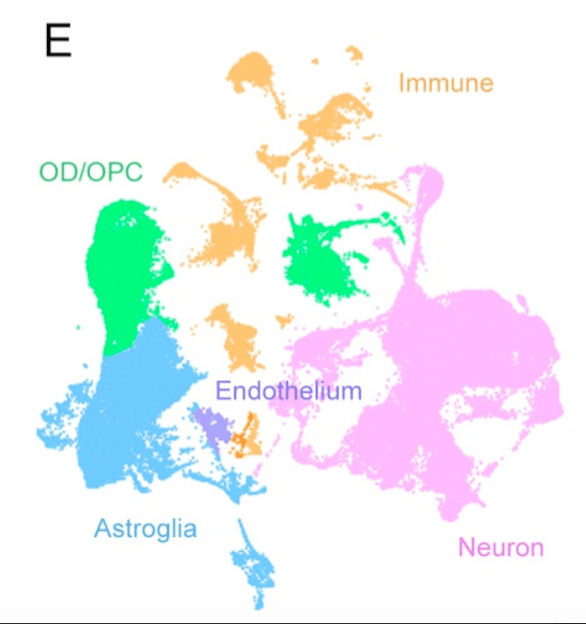
Our recent publication about comprehensive comparison of the single cell/nucleus transcriptomics profiles of human Alzheimer's brains and zebrafish Alzheimer's model is out. We found remarkable similarities and biologically meaningful differences. To compare transcriptomics data in zebrafish model of AD and Alzheimer's patients (in entorhinal cortex, superior frontal gyrus, dorsolateral prefrontal cortex), we first reliably integrated …
Missing Link Between Alzheimerโs and Vascular Disease Found?
Meeri Kim's article in the Columbia University Irving Medical Center Newsroom on our recent collaborative study with Dr. Annie Lee, Dr. Badri Vardarajan and Dr. Richard Mayeux. For more than 20 years, scientists have known that people with hypertension, diabetes, high cholesterol, or obesity have a higher likelihood of developing Alzheimerโs disease. The conditions can …
Continue reading "Missing Link Between Alzheimerโs and Vascular Disease Found?"
DZNE spotlight on our publication
Our work spotlighted by DZNE: https://www.dzne.de/en/spotlight/meldungen/2020/growing-new-neurons-learning-from-the-fish/
Our Alzheimer’s disease model in zebrafish is used for validating a drug that prevents loss of neuronal connections
A collaborative work led by Jared Sterneckert, and in which Kizil Lab was also involved, is now published in the journal Stem Cell Reports, the official journal of International Society for Stem Cell Research (ISSCR). This study identified a lead compound that inhibits CDK5 and GSK3ฮฒ, and is neuroprotective in vitro and in vivo. Prabesh …
Novel traumatic injury model of human brain developed in Kizil Lab
Our new publication on how #human #neural #stem cells could increase their ability to regenerate lost #neurons after #traumatic #brain #injury in #3D environment is out! Congratulations to all authors! https://www.frontiersin.org/articles/10.3389/fncel.2019.00023 This work was supported by Deutsches Zentrum fรผr Neurodegenerative Erkrankungen - DZNE TU Dresden IPF Leibniz Institut fรผr Polymerforschung Leibniz-Gemeinschaft Helmholtz-Gemeinschaft Deutscher Forschungszentren Deutsche …
Continue reading "Novel traumatic injury model of human brain developed in Kizil Lab"