New Paper Published: Shared Genetic Architecture Between Early-Onset Alzheimerโ€™s and Lipid Traits

We are pleased to highlight a recent publication by Ray et al. (2025) that investigates local genetic covariance between early-onset Alzheimerโ€™s disease (EOAD) and blood lipid traits. We in the Kizil Lab are proud to have contributed to this collaboration, which deepens our understanding of how lipid biology intersects with neurodegenerative risk. ๐Ÿ‘‰ Read the …

New preprint investigating the pathology mechanisms of Fibronectin at the blood-brain barrier is out

We are excited to share a new preprint from the Kizil Lab titled "APOEโ€‘ฮต4โ€‘induced Fibronectin at the bloodโ€‘brain barrier is a conserved pathological mediator of disrupted astrocyteโ€“endothelia interaction in Alzheimerโ€™s disease." In this study, we uncover a previously unknown mechanism by which the APOEโ€‘ฮต4 alleleโ€”one of the strongest genetic risk factors for Alzheimerโ€™s diseaseโ€”disrupts brain …

Our study about ABCA7-dependent genetic risk in Alzheimer’s disease is published

We are excited to share our new study on the role of the ABCA7 gene in brain resilience against Alzheimerโ€™s. Published in Cell Genomics, we found that ABCA7 is crucial for maintaining synaptic health by regulating neuropeptide Y (NPY), a key molecule for brain communication and repair. Loss of ABCA7 reduces NPY, weakening the brain's …

Collaborative Study on Molecular Insights into Blood-Brain Barrier Dysfunction in Alzheimer’s Disease Published

We are thrilled to announce our participation in a groundbreaking study in collaboration with Mayo Clinic, now published in Nature Communications. This research looks into the intricate role of blood-brain barrier disruptions in Alzheimerโ€™s disease, leveraging the remarkable capabilities of zebrafish models in combination with vast antemortem and postmortem human brain datasets. The blood-brain barrier …

We found a genetic variant that protects against Alzheimerโ€™s disease

We discovered a genetic variant that reduces the odds of developing Alzheimerโ€™s disease by up to 70% and may be protecting hundreds of thousands of people from the disease. The discovery of the protective variant, which appears to allow toxic forms of amyloid out of the brain and through theโ€ฏblood-brain barrier, supports emerging evidence that …

More neurons, less Alzheimer’s: from zebrafish to mammals

A molecular mechanism that zebrafish brain uses to regenerate neurons after neurodegeneration can help us to cope with Alzheimer's, our recent study shows. Induced neurogenesis could be a therapy option for ameliorating Alzheimer's disease pathology. Our recent publication in Nature Partner Journal Regenerative Medicine addresses whether we can use neurogenesis as a means to counteract …

Kizil Lab moves to Columbia University!

We are happy to announce that we moved to New York to the Department of Neurology and the Taub Institute in Columbia University Irving Medical Center. We are thrilled to continue and expand on our work in zebrafish on Alzheimerโ€™s disease in the great New York City at this great university! Stay tuned!

Our Viewpoint on the use of zebrafish for Alzheimer’s disease is out in ACS Chemical Neuroscience

We are happy to announce our Viewpoint in ACS Chemical Neuroscience on how zebrafish can help us to understand Alzheimer's disease pathology as well as help design new drugs. Zebrafish as an Experimental and Preclinical Model for Alzheimerโ€™s Disease (click to open the publication at the publisher's site in a separate window) Journal cover from …

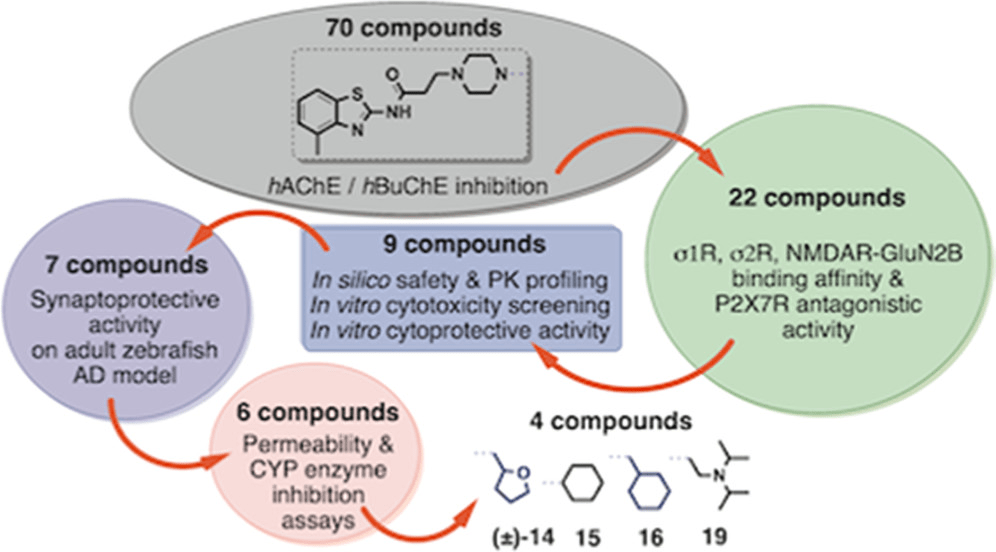
We discovered new potent multitarget lead compounds for synaptoprotection in Alzheimerโ€™s disease

Happy to announce our publication in Journal of Medicinal Chemistry: Discovery of Potent Cholinesterase Inhibition-Based Multi-Target-Directed Lead Compounds for Synaptoprotection in Alzheimerโ€™s Disease (click to open the link on the publisher's site) Graphical abstract Abstract: Drug development efforts that focused on single targets failed to provide effective treatment for Alzheimerโ€™s disease (AD). Therefore, we designed …